


Insights And Tips For Business Growth
Insights And Tips For Business Growth
Insights And Tips For Business Growth
Insights And Tips For Business Growth
Welcome to our Blog page, we not only aim to provide practical advice on business automation, efficiency, and future-ready strategies, but also reflection, thought provoking and entertaining reads. Whether you're a start-up or an established SME, our expert insights will help you streamline your systems, boost productivity, and stay ahead in a rapidly evolving marketplace.
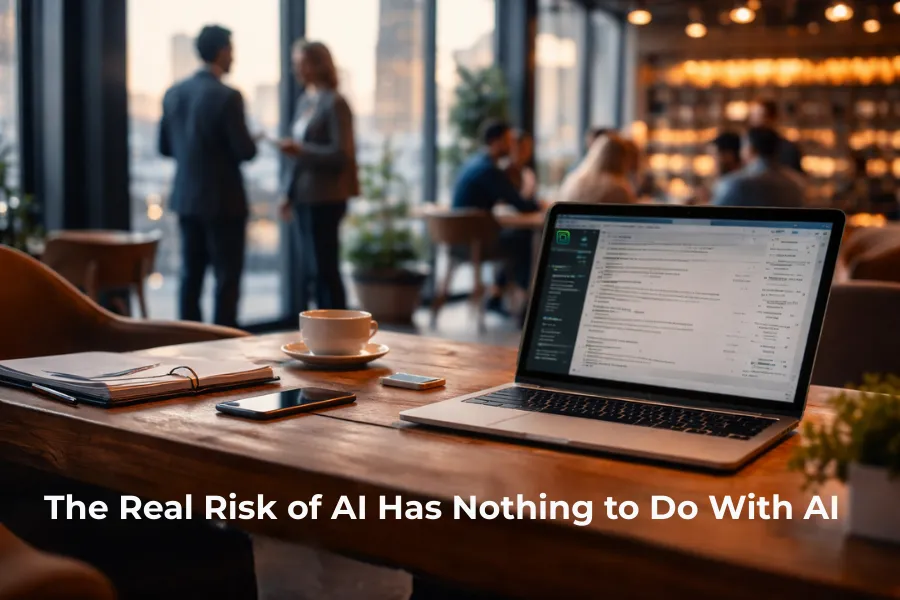
The AI Bubble Debate Is Missing the Real Risk for Small Businesses
Two stories caught my attention this week.
The first, reported in The Guardian, suggests that investors are beginning to worry the vast sums pouring into AI infrastructure could start to resemble the early 2000s dot-com bubble. Tech giants are spending extraordinary amounts building data centres, chips and new AI services, and some analysts are quietly asking whether the returns will ever justify the frenzy.
At the same time, economists and policymakers are studying something slightly different. Central banks and governments are now actively modelling how artificial intelligence might reshape labour markets, productivity and even financial systems over the next decade.
Both conversations are interesting, and both raise valid questions, but they also miss something that matters far more for small businesses. Whether AI becomes the next industrial revolution or the next tech bubble isn’t actually the biggest risk most businesses face.
The shift has already happened
When people talk about AI, they usually focus on the technology itself, the models, the tools, the capabilities; when in reality, the bigger change has very little to do with technology and a lot to do with behaviour.
Over the past decade we’ve all been quietly and subconsciously retrained as customers. We now expect quick acknowledgement when we make an enquiry, we expect booking systems to work instantly, we expect clear information without having to chase, and when that doesn’t happen, we get frustrated, don’t usually complain, but simply move on.
Those expectations didn’t start with AI. They came from years of digital platforms, systems and automations making things faster and smoother. AI simply accelerates them and that’s where the real pressure on small businesses begins to appear.
A quiet divide is forming
Over the next few years, I can see businesses are going to separate into two groups. The first group will continue operating much as they always have. Leads arrive through different channels, responses depend on when someone has a moment to deal with them, and follow-ups rely largely on memory or good intentions with information scattered across inboxes, spreadsheets and people’s heads.
These businesses will continue to function perfectly well for a while, although they will tend to feel heavier to run over time. Every new client brings more work, more communication and more mental load.
The second group will do something slightly different, they will start treating their business as a system rather than a sequence of tasks.
Enquiries are acknowledged automatically, not hours later when someone notices them. Follow-ups happen consistently because the process exists, not because someone remembered. Tasks appear where they need to appear, information is visible rather than hidden in emails, and clients experience a business that feels organised and responsive.
What’s interesting is that these businesses don’t necessarily work harder, quite the opposite in fact. In many cases they work less frantically because the structure carries some of the weight. They also become far more efficient and able to use the valuable data held within their systems.
Over time, that difference will become a competitive advantage.
Why I think the “AI bubble” debate is slightly misleading
Even if AI investment cooled tomorrow and the headlines moved on to something else, the behavioural shift would still remain, much like contactless payments or digital wallets. Boarding passes, event tickets, loyalty cards and payment methods all live in our phones now. The technology itself faded into the background quite quickly, but the expectation that things should be quick, simple and seamless never did.
The interesting thing is that when these shifts happen, they rarely feel dramatic at the time, they sneak into our everyday lives almost unnoticed. There’s no single moment where everyone decides to change how they operate. The pressure just builds slowly in the background.
The same thing is happening in business.
At first it shows up as a few missed opportunities, an enquiry that quietly disappears, a follow-up that never quite happens. Then it becomes a little more operational: days that feel busier than they should, decisions that rely on memory rather than visibility, teams spending time coordinating things that ought to move automatically.
None of these feel inconvenient or a big deal on their own and most businesses adapt remarkably well and keep delivering excellent work. But over time, the weight of those small inefficiencies starts to compound. What once felt manageable begins to feel heavy, and the business ends up relying more and more on the owner’s attention just to keep everything moving.
That’s usually the point where people start talking to me.
A simple question
When someone shows interest in your business, what actually happens next?
Not what you ‘hope’ happens, what ‘should’ happen, what you intend to do when you get five minutes or what you ‘think’ happens… What genuinely happens in reality.
Do they receive an acknowledgement quickly? Is there a clear follow-up path? Does the enquiry move smoothly through your business, does it show up in multiple places, or does it depend on whether you happen to remember?
That small moment between interest and action is where a surprising amount of opportunity quietly disappears.
The opportunity hiding inside all this noise
Whenever a new technology wave arrives, the headlines focus on the giants, the billion-pound investments, the infrastructure and the hype, but the real transformation usually happens somewhere much quieter, in the way we, everyday businesses, are organising ourselves.
Right now AI is simply making something possible for small businesses that previously required huge teams and budgets. Consistent follow-ups. Structured client journeys. Intelligent assistants that handle routine communication. Systems that connect information instead of scattering it.
None of this is about chasing trends, it’s about removing the friction that makes a business exhausting to run.
One thought to leave you with
If the AI boom turns out to be overhyped, investors will lose money. If it turns out to be genuinely transformative, entire industries will shift.
But for small businesses the more important question is much simpler. Is your business currently built on effort, or on structure?
Because the businesses that are built with the right structure early, will be the ones quietly moving ahead, regardless of what the headlines say.
Take Care
Estelle
P.S. A small thought experiment for you.
If you disappeared from your business for two weeks, what would genuinely stop working?
Not the obvious things like client delivery, but the quiet operational bits. Would enquiries still be acknowledged properly? Would follow-ups still happen? Would your team know what needs doing next? Would new opportunities keep moving forward?
Most owners assume the answer is yes until they give it some thought.
If your business still depends on you remembering, checking or nudging things along, that isn’t a failure, it’s simply a signal that your systems have quietly been built around you not for you. That’s the first thing I usually look for when helping a business become easier to run.

Reviews
Photos Courtesy of LinkeIn
Testimonials Courtesy of Go High Level

Debbie DuBois
Compass Marketing Creative
"I felt completely supported as soon as I join the platform...These guys care about my business and have taken my business to the next level. The technology is continuing to shift and change while getting better and better. They are providing new services and things that I love."
Debbie DuBois
Compass Marketing Creative
"I felt completely supported as soon as I join the platform...These guys care about my business and have taken my business to the next level. The technology is continuing to shift and change while getting better and better. They are providing new services aDividernd thing that I love."

Alex Schlinsky
Founder of Prospecting On Demand™
"I have personally provided HighLevel to all of my elite clients in my mentorship program, and they have been utilizing it for prospecting, sales, fulfillment, keeping clients longer, making sure prospects never slip through the cracks, and utilizing things to save their time. If you're considering using HighLevel, use it. It's going to help your business scale!"

Shaun Kirk
PT Practice Success Marketing Creative
"The degree of service and value is phenomenal. Anything that you can think of or dream of, then a few days later you find out that it is going to be released the next week. The amount of listening they do with their customers is amazing. WHO DOES THAT? I am eternally grateful for HighLevel!"
Alex Schlinsky
Founder of Prospecting On Demand™
"I have personally provided HighLevel to all of my elite clients in my mentorship program, and they have been utilizing it for prospecting, sales, fulfillment, keeping clients longer, making sure prospects never slip through the cracks, and utilizing things to save their time. If you're considering using HighLevel, use it. It's going to help your business scale!"
Shaun Kirk
PT Practice Success Marketing Creative
"The degree of service and value is phenomenal. Anything that you can think of or dream of, then a few days later you find out that it is going to be released the next week. The amount of listening they do with their customers is amazing. WHO DOES THAT? I am eternally grateful for HighLevel!"

Christine Seale
President & CEO of NerdLevel
"It's been a complete game-changer for me. We've built our whole business around HighLevel now. We'll never go back."
Christine Seale
President & CEO of NerdLevel
"It's been a complete game-changer for me. We've built our whole business around HighLevel now. We'll never go back."
Our Focus Is Your Growth.


© 2026 My Biz Solution Ltd - All rights reserved. Terms of Service I Privacy Policy I Acceptable Use Policy I Cookie Policy
© 2026 My Biz Solution Ltd- All Rights Reserved